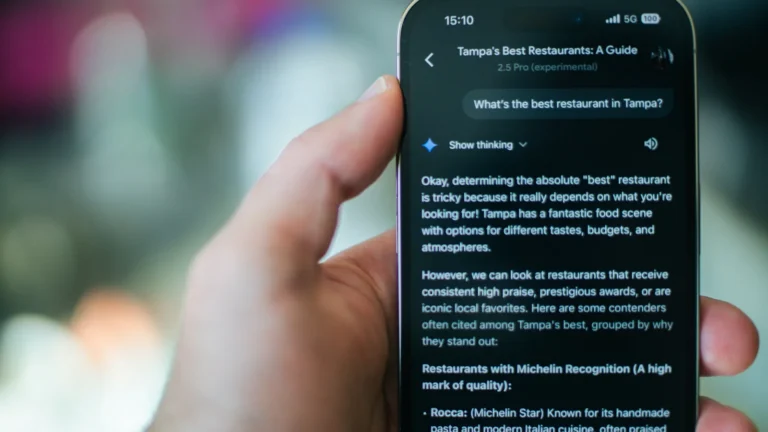

To older generations, the idea of sitting down to write with an AI writing assistant waiting at your elbow to suggest the next sentence or polish your grammar would seem like something out of a dystopian sci-fi movie. For many of us writers today, it’s no longer a scenario, but a normal moment in our daily lives. Content marketers offering services like ours, have rapidly embraced generative AI; Siege Media’s research shows that 90% of content marketing programs used AI in 2025, up from 65% of content marketers who planned to use AI tools in 2023. The promise is beguiling: faster drafts, instant ideas, and even some marketers report a boost in landing page conversions with AI-crafted copy. But are AI tools like ChatGPT or platforms founded with LLM technology actually helping us write better content, or are we at risk of becoming dependent on them?

 Generative AI is helping writers and marketers create better content, as long as we remember its role. It has potential to help us express our thoughts more clearly, explore ideas more freely, and work more efficiently. But it’s most effective when we remain the ultimate author of our content. Embrace these tools to augment your writing process, but continue to infuse your work with your own insights, humour, and humanity. By doing so, you ensure that your content isn’t just better in a technical sense; it’s genuinely better at connecting with the people who read it.
If you want to know more about how you can use AI tools for your business, book a free consultation with us here!
The Allure of AI as a Writing Partner
It’s easy to see why writers and marketers are excited. Using generative AI as a writing tool can act like a tireless brainstorming partner and editor rolled into one. It’s efficient at doing all the prep work that can eat up a writer’s time such as finding inspiration, analyzing data, researching related keywords, and outlining posts. It could be argued then, that by handling repetitive or tedious tasks, AI lets humans focus on higher-level creativity. If you’ve ever stared at a blinking cursor and a blank digital page for hours on end, an AI-generated prompt or a list of blog title ideas can feel like a lifesaver. Even on a customer success side, the results look promising. Many marketers use AI to optimize and refine content after it’s written. Think tone improvements, grammar fixes, or SEO suggestions. There are reports of AI-assisted copy improving ad click-through rates and increasing organic traffic growth within months. With stats like these, it’s no wonder content teams see AI as a powerful new tool in their arsenal.The Danger Of AI Dependency
Beyond the efficiency and numbers, something more subtle is happening. AI is changing how we write. Writers opposed to the use of AI in creative fields reflect a creeping worry that we might be leaning too much on the machine. Overreliance on AI can have unintended consequences for content quality and the writer’s craft. Yes, it can crank out a coherent blog draft in seconds or minutes, but what happens to originality, critical thinking, and that human spark when we shortcut the writing process? Critics argue that if everyone is using AI to churn out posts, much of online content could become formulaic, devoid of personality, and as a result, the AI content itself becomes a commodity. If every writer feeds similar prompts into a similar model, you might get grammatically correct content based on the style or tone that you’ve requested, but in the end, it will be a mashup of already existing ideas and soulless analysis of current issues. More concerning is the possibility that relying heavily on AI may hinder our development as writers. Writing isn’t just stringing sentences together. It’s conceptually a process of thinking and learning. Offloading that process to an AI is essentially the same as asking someone else to do your homework. There’s evidence that this overreliance dampens quality. A recent MIT study found that students who wrote essays with ChatGPT’s help actually produced lower-quality work and showed less critical thinking activity in the brain. Tellingly, 83% of the ChatGPT group couldn’t correctly quote a line from the essay they had just written (MIT Media Lab, June 2025). Rehashing machine-generated text can lead to bland, forgettable content, but even worse, it removed personal creativity and unique perspectives, which are the very qualities that make written work compelling. There’s also the risk of atrophying our “writing muscles.” Crafting a narrative or argument from scratch is a skill sharpened by practice. If we skip that exercise and let AI fill in the blanks, we may slowly lose some of our prowess in articulating thoughts unaided. Think of it like using GPS for every drive. It will get you to where you’re going (most of the time), but overreliance on it might make you forget not just how to navigate on your own, but your sense of direction. Content creators should not become passive editors of AI output. Rather, original thought and authentic voices need to be sharpened and developed through exercising our creative instincts.
Limitations and Biases of AI Writing Tools
It’s also important to remember what AI writing tools can’t do, or where they might lead you astray. Generative AI models are powerful, but they have well-documented limitations and biases that content writers must navigate.- Facts and Currency: ChatGPT doesn’t know anything beyond what it was trained on, which means it might cheerfully provide outdated information if you’re not careful. It might confidently assert “facts” that are no longer true, or never were, which can hurt your credibility if you don’t catch it. For content writers, that means fact-checking every AI-generated claim against trusted sources is a non-negotiable step.
- Bias: AI models learn from a vast swath of the internet, and that data inevitably includes biases, gaps, and even prejudices. For instance, a huge portion of ChatGPT’s training data is in English, skewing its perspective toward Western and English-speaking contexts. It may lack knowledge of niche topics or minority viewpoints simply because those didn’t feature prominently in its training. As a writer, you need to review AI’s language to ensure it’s culturally sensitive, on-brand, and appropriate for your audience. Human judgment is your safety net here.
- Originality and Creativity: AI generates content by remixing patterns it has seen before; it isn’t capable of genuine inspiration in the way humans are. If you ask an AI for a metaphor, it will give you one that’s probably been used somewhere. Truly novel ideas, quirky personal stories, and leaps of imagination are still firmly in the human domain. Your expertise and personal perspective as a content creator is irreplaceable. Use AI to refine your creative ideas, not to form them.
- The Filter Bubble: Another subtle limitation is that AI often operates within a filtered sandbox. You might remember the controversy around asking the Chinese AI platform Deepseek about Tiananmen Square, and its response, “Sorry, that’s beyond my current scope. Let’s talk about something else.” In other words, these platforms are designed to avoid certain topics or opinions deemed too controversial or harmful by their guidelines. Keep this in mind when using AI for research. Always cross-verify with traditional research methods, especially on complex or contentious topics.
AI as an Assistant, Not a Replacement
So, how do we strike the right balance? The consensus among experienced writers and marketers is to treat AI as a powerful assistant, but not a substitute for human creativity. In practice, this means using AI for what it does best, which is automating the drudgery, while ensuring the core ideas and final polish come from you. In fact, Google’s search algorithms are starting to prioritize unique, people-first content, meaning cookie-cutter AI text likely won’t rank well in the long run. YouTube has just implemented a policy demonetizing low-quality, mass-produced AI-generated videos, although critics have already argued this policy sidesteps the issue of the algorithm pushing this kind of content. Regardless, the implication is clear: pumping out generic AI-generated articles is not a viable strategy for standing out, or for SEO success. AI is best leveraged as a minor writing assistant, not a major human replacement. Ideally, it’s best used for outlining, brainstorming, and initial drafts. You could view it as an enthusiastic intern, eager to help but inexperienced and in need your guidance. Let it automate routine tasks, but always keep your voice, personal insights, and audience understanding central. Stay engaged, meticulously edit, and maintain your unique style. AI amplifies your creativity; it shouldn’t diminish or replace it.
Generative AI is helping writers and marketers create better content, as long as we remember its role. It has potential to help us express our thoughts more clearly, explore ideas more freely, and work more efficiently. But it’s most effective when we remain the ultimate author of our content. Embrace these tools to augment your writing process, but continue to infuse your work with your own insights, humour, and humanity. By doing so, you ensure that your content isn’t just better in a technical sense; it’s genuinely better at connecting with the people who read it.
If you want to know more about how you can use AI tools for your business, book a free consultation with us here!
How AI Fits Into Content Creation Today
AI now shows up at every stage of content work: researching topics, outlining, drafting, editing and repurposing a blog post into social posts or emails. Used well, it speeds up the busywork. Used carelessly, it fills blogs and feeds with the same generic text everyone else publishes, which readers and search engines learn to skip.
The businesses that win use AI for structure and speed, then add what AI can’t: first-hand experience, real examples and a clear point of view. That is also what gets content cited in AI answers. Our AI visibility optimization services build content around exactly that.