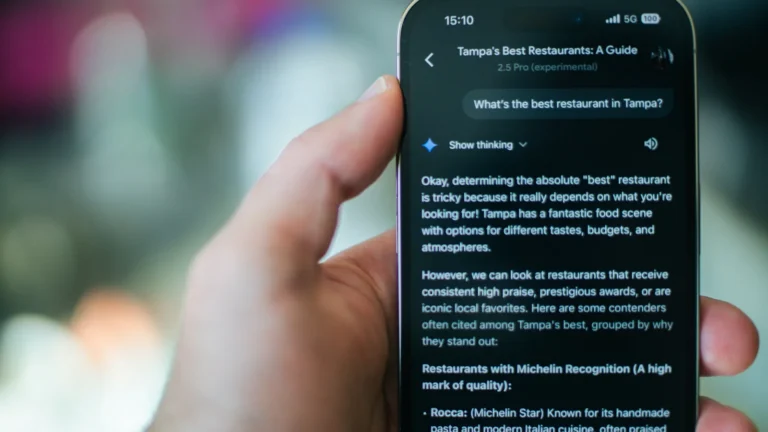

Key Takeaways
- About one in five Google searches now trigger AI Overviews (Ahrefs, 2025).
- GEO, AEO, and SEO are different: structure content as direct answers, and build the entity signals AI models use to identify and cite your business.
- Click volume is declining, but securing your brand in AI overviews has benefits; AI-referred traffic converts approximately 4.4x higher than traditional organic (Semrush, 2025).
- Local PR and original first-hand content are the highest-leverage moves for small businesses with limited budgets.
The Shift From Clicks to Citations Explained
Traditional SEO optimized for clicks. AI search optimizes for citations, or being the source an AI model selects, summarizes, and provides links when answering a user’s question. Two data points define the shift:- Clicks are declining. Seer Interactive measured organic click-through rates dropping 61% on informational queries that show an AI Overview, from 1.76% in June 2024 to 0.61% in September 2025 (Seer Interactive, November 2025). SparkToro found that about 68% of U.S. Google searches ended without a click in early 2026 (SparkToro, 2026).
- The clicks that remain convert at a much higher rate. Semrush’s 2025 study found the average AI search visitor is worth roughly 4.4x a standard organic visitor, based on conversion rate (Semrush, July 2025). Adobe Analytics, analyzing more than a trillion U.S. retail visits, found AI-referred shoppers in March 2026 converted 42% better than non-AI traffic (Adobe, April 2026).

AEO vs. GEO vs. Traditional SEO: A Practical Distinction
The terminology is new, and not every practitioner agrees on the boundaries. The pragmatic definitions are these:- Traditional SEO optimizes a page to rank in a list of links.
- Answer Engine Optimization (AEO) optimizes content to be selected as the direct answer to a specific question, whether that answer surfaces in a featured snippet, Google AI Overview, or voice assistant response.
- Generative Engine Optimization (GEO) optimizes for inclusion and citation inside large language model outputs (ChatGPT, Perplexity, Gemini, Claude, Google AI Mode).
Four Practical Moves for Small Businesses
Enterprise SEO teams have analysts, technical SEOs, and PR firms. Small businesses do not. The following four moves are accessible to a single owner or a small marketing team and produce measurable AI visibility gains.1. Build Entity Clarity Before Anything Else
AI models recommend entities, not URLs. An entity is your business as a structured concept: name, location, services, owners, hours, reviews. To strengthen entity recognition:- Verify and fully complete your Google Business Profile, including services, attributes, and Q&A.
- Ensure NAP consistency across your website, GBP, Bing Places, Apple Business Connect, Yelp, and industry directories.
- Implement LocalBusiness schema markup on your site, including sameAs references to every social and directory profile.
- Add a clearly written “About” page that states what you do, where, and for whom in plain language.
2. Restructure Content as Questions and Direct Answers
Generative engines parse content best when questions are stated explicitly and answers are direct. For FAQ pages and service pages:- Phrase each heading as a natural-language question a customer would actually type or speak.
- Provide a 40–60 word direct answer immediately under the heading, followed by supporting detail.
- Avoid burying the answer in three paragraphs of preamble.
3. Publish Original, First-Hand Information
This is where small businesses have a structural advantage over large enterprises. AI models preferentially cite sources offering information gain: data, examples, or perspective not available elsewhere on the web. For example, A regional plumber publishing “Five service calls we got after the February freeze, and what they cost” produces information gain. A national franchise re-writing the same generic blog post does not. Original photographs, case studies with real numbers, named staff quotes, and local data points are all assets that generative models reward.4. Earn Third-Party Mentions in Sources AI Engines Trust
AI engines do not synthesize from a website in isolation. They pull from reviews, local news, industry directories, podcasts, and association sites. A May 2026 analysis published in Entrepreneur, covering close to 500 local-business prompts, found that even a small amount of local press coverage can help a local firm get recommended by AI, particularly in smaller geographic markets (Entrepreneur, May 2026). This is the part most small businesses neglect. It is also the lowest-budget, highest-leverage move available.
Why This Matters Now
The window for small businesses to move on AI visibility is narrower than it appears. AI platforms recommend dramatically fewer businesses per query than traditional search engines. Businesses that establish entity clarity, structured content, and earned citations in 2026 will compound that advantage as AI search adoption accelerates. Those that wait might find the recommendation slots already filled. MGG Digital Consulting builds AI-readiness strategies specifically for small and local businesses, from the audit, the schema, the content restructuring, to the third-party citation work. If you want to know where your business currently appears in AI answers, request a AI-Readiness Audit at mggdigital.com. The audit identifies which AI engines currently cite you, where the gaps are, and what to fix first.Frequently Asked Questions
How do I get my small business to show up in ChatGPT?
Complete and verify your Google Business Profile, ensure consistent NAP data across all major directories, add LocalBusiness schema markup to your site, and earn at least a handful of third-party mentions on local or industry publications. ChatGPT retrieves real-time information from the web; if your business is structured and cited, it becomes citable.Is AEO the same as SEO?
No. SEO targets ranking positions in a list of links. AEO targets selection as a direct answer inside a featured snippet, AI Overview, or voice response. The technical signals overlap heavily, but the content structure differs — AEO requires explicit question-and-answer formatting.How is GEO different from AEO?
AEO optimizes for being the direct answer inside any answer-style result. GEO is narrower and focuses on being cited or mentioned inside large language model outputs from ChatGPT, Perplexity, Gemini, and similar engines.Does Google AI Overviews kill my organic traffic?
It reduces click-through volume on informational queries, but the visitors who do click convert at materially higher rates. The net business impact depends on conversion economics, not raw session counts.Can a small business compete against national brands in AI search?
Yes, particularly for local-intent queries. AI platforms appear to favor local SMBs over multi-location brands in recommendation contexts, and original, first-hand content from a local operator provides the “information gain” that generative models reward.If you want your business cited in ChatGPT, Gemini and Google’s AI Overviews, our AI visibility optimization services put these steps into practice.